
At All Weather Heating & Cooling, our experts perform a lot of HVAC upgrades. We handle every type of heating and cooling technology, as well as insulation and other related items. It’s common for homeowners to spend money on upgrades without considering one of the most important features of the HVAC system: the thermostat.
An upgrade to your thermostat is necessary at least every decade or so to ensure your HVAC system is operating at the highest possible capacity allowed by current technology levels. If you haven’t upgraded yours in a while, you might be due. Here are five reasons why you should upgrade your thermostat this year and how doing so can improve your quality of life while reducing your overall energy consumption.
1. Better Temperature Control
The primary purpose of a thermostat is to give the homeowner control of the temperature in their house. It acts as the brain and central nervous system of the HVAC unit, relaying signals to the rest of the machinery to instruct it when to switch on and off and at what capacity to operate.
By investing in an upgraded, modern thermostat, it’s possible for a homeowner to achieve a greater degree of temperature control than ever before. These modern units utilize advanced components called thermistors, which are far more sensitive to variations in temperature than older thermometers used in home heating. Modern thermostats may also utilize room sensors, which can help provide a more accurate overall reading of an entire room.
When combined with cutting-edge programmable software, these components allow users to achieve a far greater degree of control over their indoor environment, improving comfort (more on this in a moment) and reducing waste in the process.
2. Improved Energy Efficiency
Each year, the average American household wastes $200 to $400 in excessive energy costs linked to an inefficient HVAC system. When the energy bills are high, many homeowners avoid turning up their heat under the assumption that they simply cannot afford to pay for the fuel to keep their house at a comfortable temperature. However, in many cases, it’s not actually the price of fuel that is too high; rather, the inefficiency of the machinery is overworking the HVAC system and driving up the costs.
There are many effective methods for improving the energy efficiency of the home, but upgrading to a smart thermostat is one of the best ways to do so. A smart thermostat helps ensure your HVAC system doesn’t use more energy than necessary.
For instance, it can learn your habits and then reduce the output of the system when less heat is required, such as at night. It can also switch the system off when it determines no one is home and then gradually heat the house back up at the time you typically return. This method of heating is far more efficient than simply turning the system on high as soon as you arrive home or leaving it on the whole time you’re out.
3. Lowered Utility Bills
It may come as no surprise that an upgrade to your thermostat can also help reduce your utility bills. Just improving your system’s energy efficiency lowers your energy costs. However, a new thermostat can take the benefits further.
Data
Modern thermostats collect data as they operate, providing the homeowner with a record detailing their home’s energy consumption. This information can prove incredibly useful for understanding when energy use is peaking, what’s causing the hike, and whether anything can be done to minimize or repair it.
For instance, a simple change in behavior may be all that’s needed to reduce the amount of time the furnace is left running. If the data shows a steady increase in energy use over time, it could indicate a leaking air duct or clogged filter, both issues that can be easily addressed with a call to a trusted HVAC service.
Zones
A thermostat upgrade can also help to lower utility bills by giving the homeowner control over heating and cooling in individual rooms. This is called zone heating.
When your home is divided into HVAC zones, it’s possible to heat only the rooms that are currently being occupied. So, if everyone is together in the living room, heat can be directed to that specific area without expending energy to keep the rest of the house at the same temperature. Then, when everyone heads to bed, the thermostat can redirect the heat to the bedrooms and allow the living room to cool. In this way, utility costs are reduced by not wasting heat energy on empty rooms.
4. Increased Comfort
A dramatic increase in the comfort level of the home is another major benefit that accompanies a thermostat upgrade. Thermistors are a major contributor to this, as traditional thermostat technology often leaves unwanted hot or cold spots within a room. This is partly because outmoded thermostat technology can’t detect the temperature in an entire room—just in a given area. The addition of better temperature-sensing features, however, enables an HVAC system to provide more accurate temperature readings and, consequently, a more comfortable, evenly heated environment.
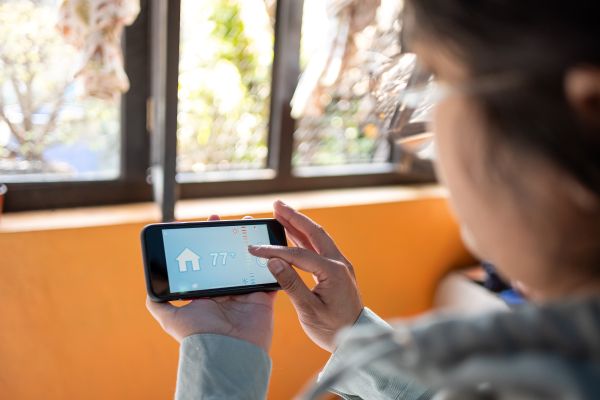
Modern thermostats can also improve comfort through enhanced convenience. Many thermostats are now wired to use the home’s Wi-Fi, which allows the homeowner to control their HVAC system using their smartphone. Residents can adjust the temperature without leaving the comfort of their favorite armchair or sofa. They can also make adjustments when they aren’t home, ensuring the indoor temperature is exactly how they want it when they get there.
5. Enhanced Smart-Home Features
A thermostat upgrade that includes the features listed above can truly bring a home to the cutting-edge of comfort and convenience. However, other enhanced smart-home features can take the technology even further, providing homeowners with the ultimate in modern HVAC technology.
For instance, the ability to control your thermostat with your smartphone has even more benefits when you’re away from home. Not coming home after work as expected? Reset the thermostat at a lower temperature until you do get home. Forget to turn down the thermostat before heading on vacation? No problem. Simply log into your app from anywhere and program the thermostat accordingly.
Your Wi-Fi-enabled thermostat can also connect to your digital assistant, allowing you to control the temperature with a simple voice command.
We already mentioned that the thermostat can gather data to monitor energy usage in the building. The best models can do even more than that, doubling as air-quality sensors and even as gas and smoke alarms.
If any of the possibilities we’ve listed intrigue you and you’d like to discuss an upgrade to your thermostat, contact All Weather Heating & Cooling. Our experienced, certified experts can help bring your home into the twenty-first century with a thermostat upgrade that fits your needs.